Poqolorex
Echo Library
Echo Library
Couldn't load pickup availability
1. Problem Statement
Many learners create useful prompts, notes, outlines, and draft fragments, but they often lose them after one writing session. Over time, the same content problems appear again: unclear tone, weak structure, repeated wording, scattered ideas, and drafts that need heavy revision. Without an organized system, learners may spend too much time rebuilding the same planning steps from the beginning. AI-assisted content work becomes more useful when learners keep a thoughtful record of what works, what needs editing, and what fits their preferred style. Echo Library is made for learners who want to collect, organize, and reuse their creative materials with more care.
2. Course Response
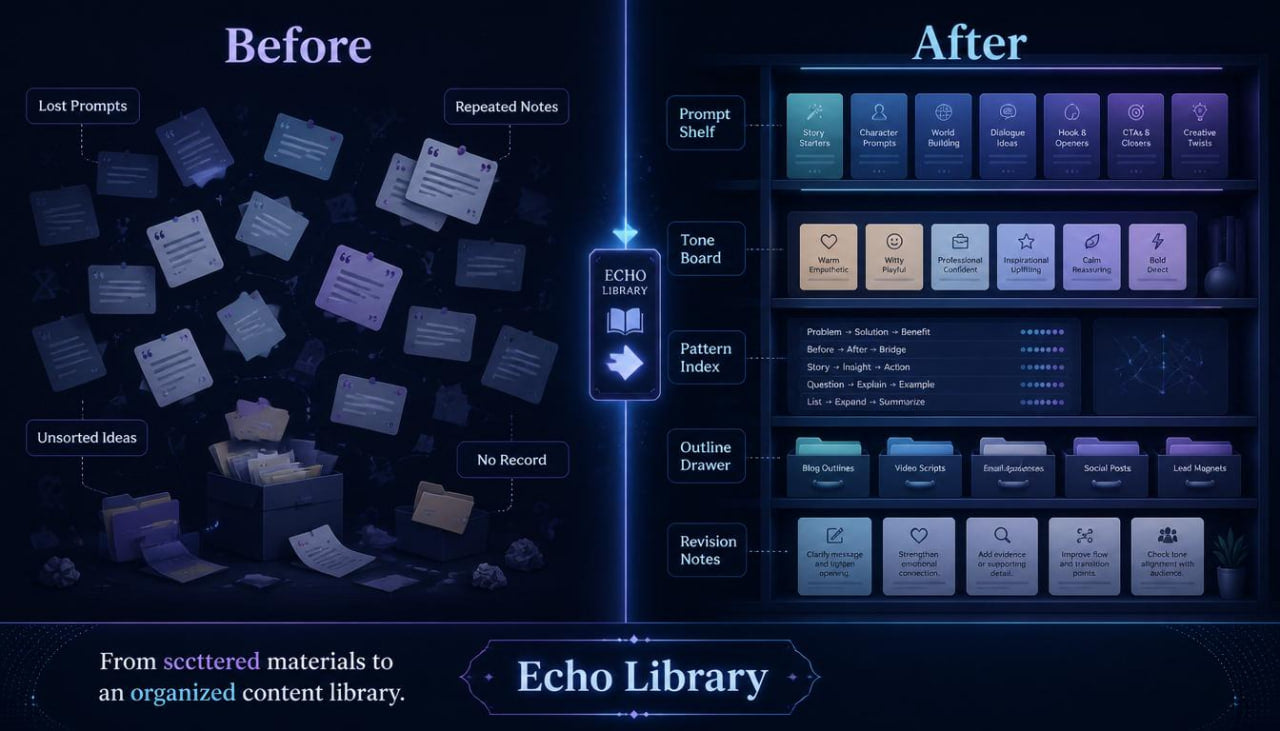
Echo Library teaches learners how to create a personal content resource library for AI-assisted writing and planning. The course shows how to save prompt patterns, tone notes, content angles, outline styles, editing instructions, and page-section templates in a structured way. Learners practice building reusable materials that can guide future drafts while still leaving space for human creativity and revision. The course also explains how to review stored prompts and improve them based on real writing needs. Instead of relying on random requests, learners create a practical library that grows through steady use and thoughtful editing.
3. What’s Inside
Echo Library includes a detailed collection of materials focused on organization, repeatable writing patterns, and careful AI guidance.
The first material is the Prompt Shelf Builder. This worksheet helps learners collect prompts by category, such as idea planning, outline creation, tone adjustment, headline drafting, section writing, FAQ building, and revision. Each prompt entry includes space for the task, intended use, audience notes, tone direction, and editing reminders.
The second material is the Message Pattern Index. This guide teaches learners how to recognize recurring content shapes. For example, one message may follow a problem-to-method structure, another may use a question-and-answer format, while another may move from idea to example to reflection. Learners can save these patterns and reuse them when creating course descriptions, educational pages, learning notes, or brand copy.
Echo Library also includes the Tone Reference Board. This material helps learners collect wording samples that match different creative voices, such as calm, thoughtful, instructional, warm, precise, or editorial. Each tone reference includes guidance on sentence length, word choice, level of detail, and how to avoid exaggerated language.
Another part of the course is the Content Angle Archive. This worksheet helps learners store different ways to approach a topic. A single subject can be shaped as a beginner explanation, checklist, comparison, reflective note, guided exercise, short educational block, or long-form outline. The archive helps learners choose a direction before drafting.
The course includes the Reusable Outline Drawer. This section gives learners several outline formats for content creation, including course page descriptions, About page sections, Contact page text, FAQ blocks, benefit-style sections, and educational introductions. Each outline includes notes on where to place the main idea, supporting details, examples, and closing text.
Echo Library also provides the AI Request Card System. These cards break AI requests into parts: topic, task, audience, tone, format, structure, wording restrictions, and review criteria. Learners can combine the cards to build stronger prompts without starting from nothing each time.
The next material is the Revision Echo Sheet. This worksheet helps learners record how a prompt performed after use. It asks what the draft did well, what felt unclear, what had to be rewritten, and which instruction should be changed next time. This turns each content session into material for the learner’s growing library.
Another section is the Safe Course Copy Guide. This guide gives wording patterns for educational course pages while avoiding exaggerated claims, pressure phrases, named third-party services, and financial language. It includes examples for headings, subtitles, short descriptions, FAQ answers, and refund notes.
Echo Library also includes the Content Memory Map. This planning sheet helps learners connect different pieces of writing so they feel related. For example, a course description, FAQ section, email note, and About page paragraph can share the same tone and message direction. The map helps learners keep their materials consistent without repeating the same text everywhere.
The course also contains the Library Clean-Up Checklist. This checklist helps learners review their saved prompts and materials from time to time. It guides them to remove unclear instructions, update tone notes, combine similar prompts, and mark which resources are useful for future writing sessions.
Finally, Echo Library includes Practice Tasks. Learners build a small prompt library, write two content outlines, create a tone board, revise one AI request, and organize their materials into categories. Each task is designed to support steady learning through direct practice.
4. Who Is This For?
Echo Library is for learners who already use AI-assisted writing for content tasks and want a more organized way to save and reuse their materials. It is useful for creators, course builders, educators, writers, and small teams who work with repeated content formats.
This course fits learners who create page copy, educational sections, learning materials, content outlines, and brand notes. It is also helpful for people who often rewrite similar prompts because they do not have a saved system.
Echo Library is especially suitable for learners who want their content process to feel more consistent. It supports better organization, stronger prompt habits, and thoughtful review without relying on bold claims or unrealistic language.
5. What You’ll Learn
- How to organize prompts by task and content type
- How to build a reusable prompt library
- How to save tone references for future writing
- How to create content angle collections for different topics
- How to store outlines for course pages and learning materials
- How to build AI requests from smaller instruction parts
- How to review prompts after each writing session
- How to refine stored materials over time
- How to keep course copy calm, clear, and learning-focused
- How to connect related page sections through shared tone
- How to reduce repeated planning work through organized resources
- How to keep human editing central in AI-assisted content creation
6. 30-Day Refund Note
Echo Library is covered by the Poqolorex 30-day refund period for paid courses. Learners may request a payment return within 30 days according to the store’s refund terms. This note is included to keep purchase terms clear while the course page stays focused on learning, organization, and practical creative materials.
Self-paced learning overview
- 📁 Digital file available after purchase
- 🗂️ Long-term availability
- 🔐 Secure checkout
- 📝 Content updated in 2026
What is Poqolorex about?
What is Poqolorex about?
Poqolorex offers AI-focused courses, lessons, modules, materials, and resources for content creation. The materials are built for learners who want a structured way to explore ideas, prompts, planning, writing, and creative organization.
Do I need prior AI knowledge?
Do I need prior AI knowledge?
No prior AI background is required. The courses are written with clear guidance, practical examples, and learning steps that help you understand each topic at a comfortable pace.
Are the materials tied to specific apps or programs?
Are the materials tied to specific apps or programs?
No. Poqolorex keeps the learning focused on content thinking, AI-supported workflows, idea development, and creative structure without naming specific apps, programs, services, or operating systems.
Share