Poqolorex
Anchor Series
Anchor Series
Couldn't load pickup availability
1. Problem Statement
As learners create more AI-assisted content, the main challenge often becomes consistency. A person may have strong ideas, useful notes, and many draft sections, yet the full learning experience can still feel loose when there is no stable foundation. Course descriptions, module outlines, FAQ answers, resource notes, and page sections all need to work together with the same direction. When that direction is missing, the writing may become repetitive, unclear, or too far away from the original topic. Anchor Series was created for learners who want a grounded method for holding larger content sets together.
2. Course Response
Anchor Series gives learners a structured way to build and review larger AI-assisted content projects. The course begins with a central planning document that defines the main theme, reader needs, tone, structure, and wording boundaries. From there, learners create prompts, outlines, page sections, module notes, and review checklists that all stay connected to the same foundation. The course teaches learners how to use AI as a writing support while keeping human judgment, editing, and creative direction at the center. Its focus is on steady learning, organized materials, and practical content development.
3. What’s Inside
Anchor Series includes a detailed set of materials for learners who want a full content planning system for AI-assisted educational writing.
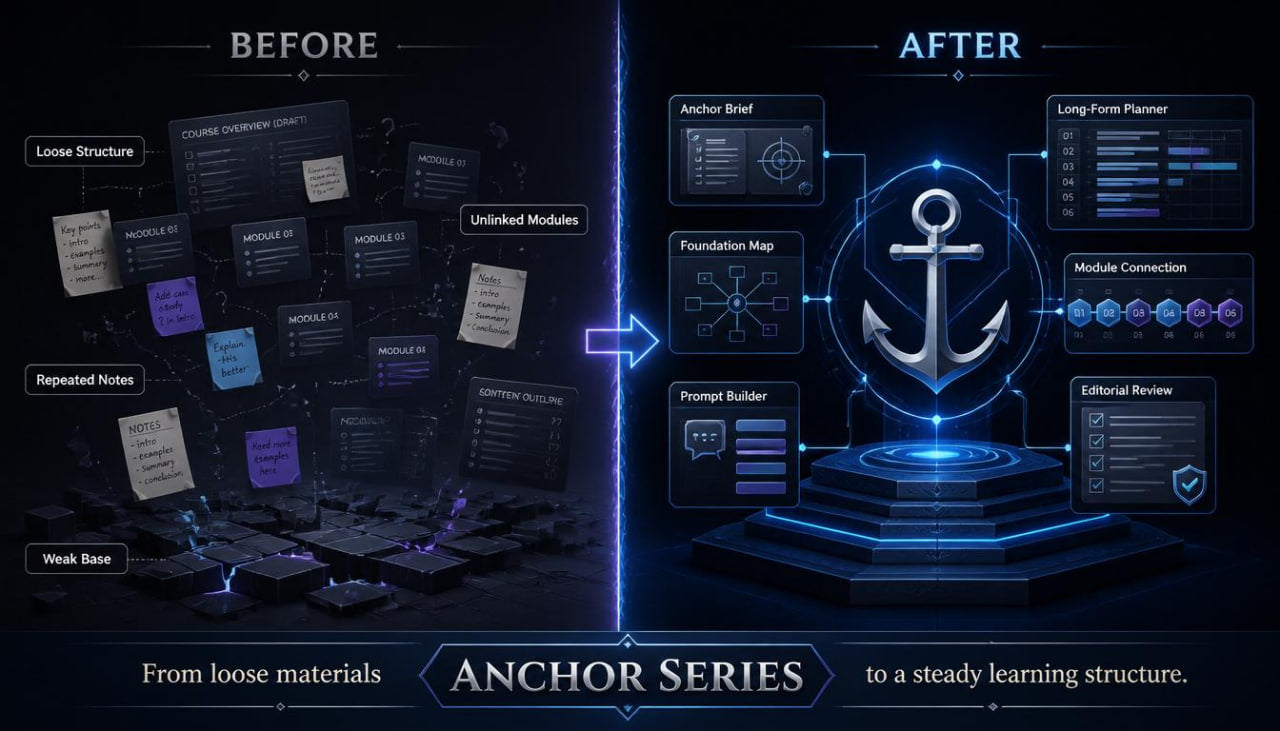
The first material is the Anchor Brief. This document helps learners define the foundation of a content project before drafting begins. It includes sections for the main topic, reader profile, learning purpose, tone direction, course structure, key ideas, wording boundaries, and review notes. Learners can return to this brief whenever a draft starts moving away from the planned direction.
The second material is the Foundation Map. This worksheet helps learners connect the main idea with every part of the course page or learning sequence. It shows how the headline, subtitle, description, inside materials, learner-fit section, skill points, FAQ answers, and refund note can all reflect the same message without repeating the same phrases.
The course also includes the Anchor Prompt Builder. This guide helps learners create detailed AI requests based on the Anchor Brief. Each prompt includes topic context, reader notes, tone guidance, section task, format needs, length direction, and editing instructions. Learners can use this builder for course descriptions, module summaries, resource pages, educational blocks, and longer written materials.
Another part of Anchor Series is the Long-Form Structure Planner. This planner helps learners arrange longer content into clean sections. It covers opening context, core explanation, supporting examples, guided practice, reflection notes, and closing direction. This is useful for learners who want to create deeper materials without losing the reader along the way.
The course includes the Module Connection Sheet. This worksheet helps learners connect several learning modules around one theme. Each module has space for a topic, key concept, short explanation, practice activity, review question, and link to the wider course direction. This helps the full learning path feel more organized.
Anchor Series also provides the Content Stability Checklist. This checklist helps learners review whether each section still matches the original brief. It asks whether the tone is steady, whether the key idea is visible, whether the section has a clear role, whether the language stays grounded, and whether any phrase feels too strong for an educational course page.
The next material is the Prompt Correction Notes. This resource helps learners revise AI requests when the result does not match the intended structure. It includes directions for asking for more detail, cleaner organization, a softer tone, stronger section order, clearer examples, or a more concise version. These notes help learners adjust the process with care.
Another section is the Course Page Anchor Template. This template guides learners through a full course page structure. It includes headline, subtitle, short introduction, problem section, course response, inside materials, learner fit, skill points, refund note, and contact direction. Each part includes neutral wording reminders for education-focused copy.
Anchor Series also includes the Resource Organization Board. This board helps learners arrange prompts, worksheets, outlines, notes, examples, and review materials into clear categories. It is useful for learners who are building a larger set of content resources and want them to stay organized over time.
The course also contains the Editorial Review Sheet. This sheet helps learners read their final content with a careful editorial lens. It guides them to check flow, tone, message clarity, repetition, section order, and wording choices. It also reminds learners to keep final edits human-led.
Finally, Anchor Series includes Practice Materials. Learners create an Anchor Brief, draft a full course page outline, build several AI prompts, write module notes, review the sections, and revise the final copy using the Content Stability Checklist.
4. Who Is This For?
Anchor Series is for learners who want to create larger AI-assisted content sets with more structure. It is useful for course builders, educators, writers, creative teams, and learners who work with long-form educational materials.
This course fits people who already understand prompt writing and content planning but want a stronger foundation for bigger projects. It is also helpful for learners who need several page sections, modules, and resources to follow the same creative direction.
Anchor Series is a good fit for learners who value careful editing. The materials guide them to plan first, draft with context, review each section, and revise the final text so it feels organized and learning-focused.
5. What You’ll Learn
- How to create a central brief for larger AI-assisted content work
- How to connect course page sections around one theme
- How to write detailed prompts based on a shared planning document
- How to organize long-form educational content into clear sections
- How to plan modules that follow the same course direction
- How to review drafts for tone, structure, and message clarity
- How to adjust AI requests when a draft needs more direction
- How to arrange prompts, worksheets, outlines, and notes into resource groups
- How to write course page sections with calm educational wording
- How to reduce repeated phrasing across related materials
- How to keep human editing central throughout the content process
- How to create a steady planning routine for AI-assisted learning materials
6. 30-Day Refund Note
Anchor Series is included in the Poqolorex 30-day refund period for paid courses. Learners may request a refund within 30 days according to the store’s refund terms. This note keeps purchase terms clear while the course page stays focused on structured learning, practical materials, and thoughtful content development.
Self-paced learning overview
- 📁 Digital file available after purchase
- 🗂️ Long-term availability
- 🔐 Secure checkout
- 📝 Content updated in 2026
What is Poqolorex about?
What is Poqolorex about?
Poqolorex offers AI-focused courses, lessons, modules, materials, and resources for content creation. The materials are built for learners who want a structured way to explore ideas, prompts, planning, writing, and creative organization.
Do I need prior AI knowledge?
Do I need prior AI knowledge?
No prior AI background is required. The courses are written with clear guidance, practical examples, and learning steps that help you understand each topic at a comfortable pace.
Are the materials tied to specific apps or programs?
Are the materials tied to specific apps or programs?
No. Poqolorex keeps the learning focused on content thinking, AI-supported workflows, idea development, and creative structure without naming specific apps, programs, services, or operating systems.
Share